Understanding Cognitive Task Analysis and Its Role in Expert Decision-Making
- Philip Burgess
- Dec 23, 2025
- 3 min read

By Philip Burgess | UX Research Leader
When I first encountered Cognitive Task Analysis (CTA), I was struck by how much it reveals about the hidden mental steps experts take during complex tasks. Unlike traditional task analysis, which focuses on observable actions, CTA digs into the thought processes behind decisions. This approach has transformed how I understand expert performance, especially in fields where decisions must be quick, accurate, and based on deep knowledge.
CTA helps unpack the mental strategies experts use, making it easier to train others, improve workflows, and design better tools. In this post, I’ll share what I’ve learned about CTA, how it works, and why it matters for anyone interested in expert decision-making.
What Is Cognitive Task Analysis?
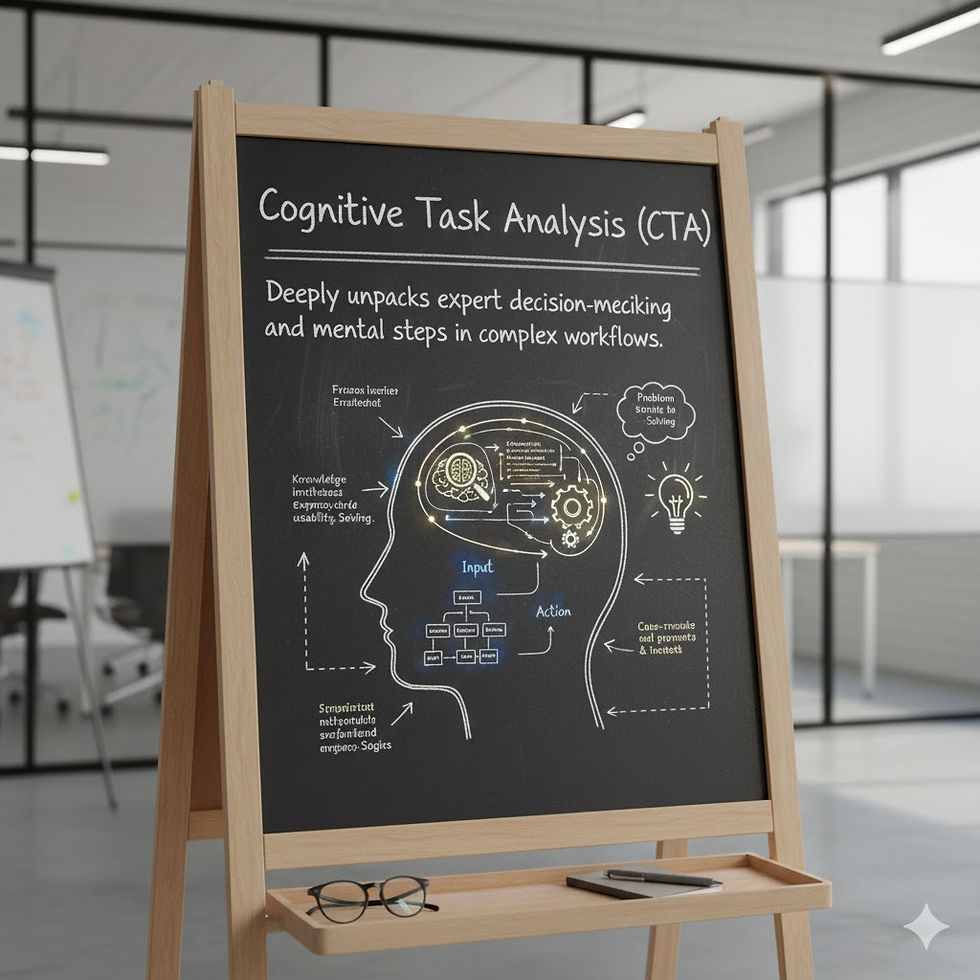
Cognitive Task Analysis is a method used to understand the mental activities involved in performing complex tasks. Instead of just looking at what people do, CTA focuses on how they think, decide, and solve problems. It reveals the knowledge, judgments, and strategies that experts use but often take for granted.
For example, a pilot landing a plane or a surgeon performing an operation relies on mental steps that are not obvious to an outside observer. CTA helps capture these steps by asking experts to explain their thought process, often through interviews, observations, and simulations.
How CTA Reveals Expert Decision-Making
Experts often make decisions based on experience, intuition, and pattern recognition. These mental shortcuts are difficult to articulate but crucial for success. CTA breaks down these complex decisions into understandable components by:
Identifying key decisions and judgments made during a task
Exploring how experts recognize patterns and cues
Understanding how they anticipate problems and plan ahead
Capturing how they adapt when unexpected situations arise
By mapping these mental steps, CTA provides a clear picture of how experts think, which can be shared with learners or used to improve systems.
Practical Examples of CTA in Action
I’ve seen CTA applied in many fields, and its impact is clear. Here are a few examples:
Healthcare: Nurses and doctors use CTA to improve training for emergency situations. By understanding how experienced clinicians prioritize actions and interpret symptoms, training programs become more realistic and effective.
Aviation: CTA helps flight instructors teach pilots how to handle rare but critical events, like engine failures. Instead of just practicing procedures, pilots learn the reasoning behind decisions, improving their ability to respond under pressure.
Manufacturing: In complex assembly lines, CTA identifies how skilled workers detect and fix errors quickly. This knowledge helps design better tools and workflows that support decision-making on the spot.
These examples show how CTA goes beyond surface-level tasks to reveal the mental work that drives expert performance.

Steps to Conduct a Cognitive Task Analysis
If you want to apply CTA, here’s a straightforward approach based on my experience:
Select the Task and Experts
Choose a complex task where expert decision-making matters. Find experts willing to share their insights.
Gather Data
Use interviews, observations, and think-aloud protocols where experts explain their thought process while performing the task.
Identify Key Decisions and Knowledge
Analyze the data to find critical decisions, cues experts notice, and strategies they use.
Create a Cognitive Model
Build diagrams or flowcharts that represent the mental steps and decision points.
Validate and Refine
Review the model with experts to ensure accuracy and completeness.
Apply the Findings
Use the insights to improve training, design tools, or optimize workflows.
This process takes time but yields valuable insights that are hard to get otherwise.
Why CTA Matters for Learning and Performance
One reason CTA stands out is its focus on making invisible knowledge visible. When experts perform well, they often can’t explain how they do it. This “tacit knowledge” is crucial for success but difficult to teach. CTA bridges this gap by making mental steps explicit.
For learners, this means:
Clearer understanding of what to focus on
Better preparation for real-world challenges
Faster skill development through targeted practice
For organizations, CTA helps design systems and tools that support expert thinking, reducing errors and improving outcomes.
Challenges and Tips for Using CTA
CTA is powerful but not without challenges. Experts may struggle to explain their thinking, especially if it’s automatic. To overcome this:
Use multiple data collection methods to capture different perspectives
Encourage experts to describe specific examples, not just general ideas
Be patient and build trust to get honest, detailed insights
Also, keep the analysis focused on decisions and knowledge that truly impact performance. Avoid getting lost in minor details.


Comments